
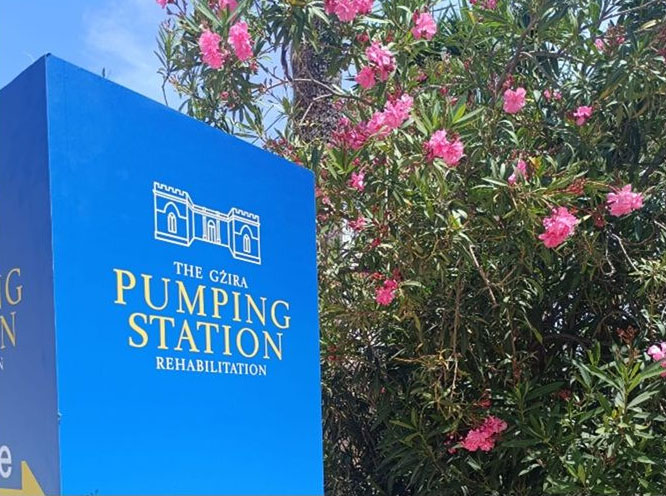
The €10 million project, announced by Minister for the Environment, Energy and Public Cleanliness Miriam Dalli and Minister for Home Affairs, Security and Employment Byron Camilleri, will see the Grade 1 Neo-Gothic building restored, its operational systems upgraded, and the previously closed site reconnected with the Gżira community. The pumping station, which dates back to the late nineteenth century, is a scheduled monument and an important pillar in Malta's water infrastructure heritage.
Positioned as a project of national interest, the rehabilitation brings together several national priorities: safeguarding industrial and architectural heritage, modernising essential water infrastructure, regenerating urban land, expanding public open space, and creating a new civic hub in one of Malta's densely populated localities. It also forms part of the wider direction of Malta Vision 2050, particularly its emphasis on regenerating green open spaces, improving urban quality of life, and making better use of existing built and natural assets.
A historic site reopened after more than a century
The Gżira pumping station has long stood as one of the locality's most distinctive historic structures, but its grounds have remained closed off from public life. Through this project, the Water Services Corporation will restore the building and open the surrounding area as a garden designed for daily community use, educational visits and local activities.
The government's announcement described the project as one that will "reopen the site's doors" after more than 100 years and turn the surrounding land into a public garden. The restored space will include shaded seating areas, smaller gathering spaces, low-impact paving, lighting, and sustainable rainwater systems. New entrances from Luqa Briffa Street and D'Argens Street will reconnect the site with the surrounding urban fabric, while a wall that has separated the area from the street will be redesigned to become more open and inviting.
Minister Miriam Dalli framed the project as an example of how heritage and modern infrastructure can work together rather than compete with each other. She said the garden will serve everyday community life, giving children space to play, older residents shaded areas to enjoy, and residents a place where activities can be organised within their own locality.
Heritage restoration with operational upgrades
The project is not limited to beautification. It will also upgrade the pumping station's systems so the site can continue serving Malta's water infrastructure more efficiently and with less noise. Water Services Corporation CEO, Karl Cilia, described it as one of the most important heritage interventions ever undertaken within Malta's water infrastructure, noting that it is rare for a single project to deliver heritage, environmental, operational and public-space benefits at once.
Earlier planning details show that the proposal includes restoration of the Grade 1 scheduled building, reconstruction of its back wing, upgrading of the grounds with a public garden and underground reservoir, rebuilding of the chimney, and reinstatement of a boundary wall overlooking Triq Luqa Briffa.
The site's heritage value extends beyond the main Neo-Gothic building. The complex also includes a reinforced concrete water tower, likely dating from the second half of the twentieth century, as well as wartime shelters of cultural heritage value. The rehabilitation plans also include consideration of the use of spaces, preservation of surviving machinery and pipework, and careful restoration of the concrete tank under expert guidance.
A new civic role for Gżira
Once completed, the restored pumping station will also host the Gżira Local Council, giving the building a renewed civic function. This adds another layer to the project's national and local importance: a formerly closed infrastructure site will become both a restored heritage landmark and an active public building.
The design was first developed internally by the Water Services Corporation and is now being taken forward with AP Valletta, a Maltese studio specialising in sustainable heritage. The restoration of the reinforced concrete water tower is being led by the University of Malta's Faculty for the Built Environment, headed by Professor Ruben Paul Borg.
Part of Malta's long-term urban vision
The rehabilitation of the Gżira pumping station reflects the kind of integrated regeneration promoted by Malta Vision 2050: making better use of existing urban land, improving public access to open spaces, protecting heritage assets, and creating more liveable neighbourhoods.
For Gżira, the project promises a new green lung and community space. For Malta, it represents a model for how nationally significant infrastructure can be preserved, modernised and opened up for public benefit.
By restoring a historic water facility while creating a public garden and civic hub, the project turns a once-hidden piece of Malta's infrastructure into a national-interest investment in heritage, sustainability and community life.
View project details